Abstract
The rapid advancement of Artificial Intelligence (AI) has created a sense of anxiety within every profession, mirroring the panic experienced by mathematicians during the advancement of calculators. This paper explores this compelling analogy, arguing that the underlying concerns range from job displacement and deskilling to the redefinition of the workplace environment. Through a comparative historical analysis of the calculator's impact on mathematicians and an empirical investigation of contemporary engineers' perceptions of AI, this paper identifies critical research gaps. It advocates for targeted research focusing on the complex and interesting psychological impacts on practicing engineers and other work personnel. This paper projects deeper historical analysis of professional mathematicians' adaptation, and the development of strategies to foster human-AI collaboration that prioritizes support over fear.
1. Introduction
The relentless march of technological progress invariably brings with it periods of profound professional introspection and, often, apprehension. Just as the abacus gave way to the slide rule, and the slide rule to the electronic calculator, so too is human intelligence now facing its most sophisticated algorithmic counterpart in Artificial Intelligence. For engineers, a profession intrinsically linked to innovation and problem-solving, AI's rapid integration into design, analysis, and execution processes presents a unique challenge that evokes historical echoes. This paper posits a compelling analogy: engineers' current anxieties surrounding AI parallel the fears mathematicians once held regarding the widespread adoption of calculators.
The initial introduction of calculators was met with skepticism, particularly within educational spheres, where concerns about students' conceptual understanding and the potential for "deskilling" were rampant. Similarly, engineers today express apprehension about AI's impact on their roles, job security, and the very essence of their specialized expertise. This research aims to delve into this analogy, highlighting the commonalities in these fears while acknowledging the distinct complexities presented by AI. By drawing parallels, this paper seeks to offer insights into understanding and managing the current technological transition within engineering, identifying critical gaps in existing research that warrant further exploration.
2. The Historical Precedent: Mathematicians and the Calculator
The introduction of the electronic calculator in the 1970s marked a significant turning point in mathematics, much like AI is doing for engineering today. Initially hailed as tools for efficiency, calculators quickly became subjects of intense debate, especially within mathematics education.
2.1. Initial Apprehension and Educational Concerns
The primary "fear" among mathematicians and educators regarding calculators stemmed from a concern about deskilling and the potential erosion of fundamental arithmetic and computational abilities. Scholars like H.L. Lee (1998) meticulously documented these anxieties, particularly:
- Loss of Conceptual Understanding: Educators worried that students would become reliant on calculators to produce answers without grasping the underlying mathematical principles. For instance, a calculator might provide "0.25" for 16^(-1/2), but without manual calculation, the student might not understand the relationship between fractional exponents and roots (e.g., 1/4).
- Reinforcement of Procedural Thinking: There was a concern that calculators would encourage a purely procedural view of mathematics, hindering the development of abstract and structural problem-solving skills crucial for advanced mathematical thought.
- Misleading Information and Over-reliance: Early calculators, and even advanced graphing calculators, could sometimes display misleading information or produce errors due to display limitations or user input, fostering an uncritical acceptance of results. This led to fears of students over-relying on the tool instead of developing robust internal verification mechanisms.
2.2. Professional Adaptation and Evolution
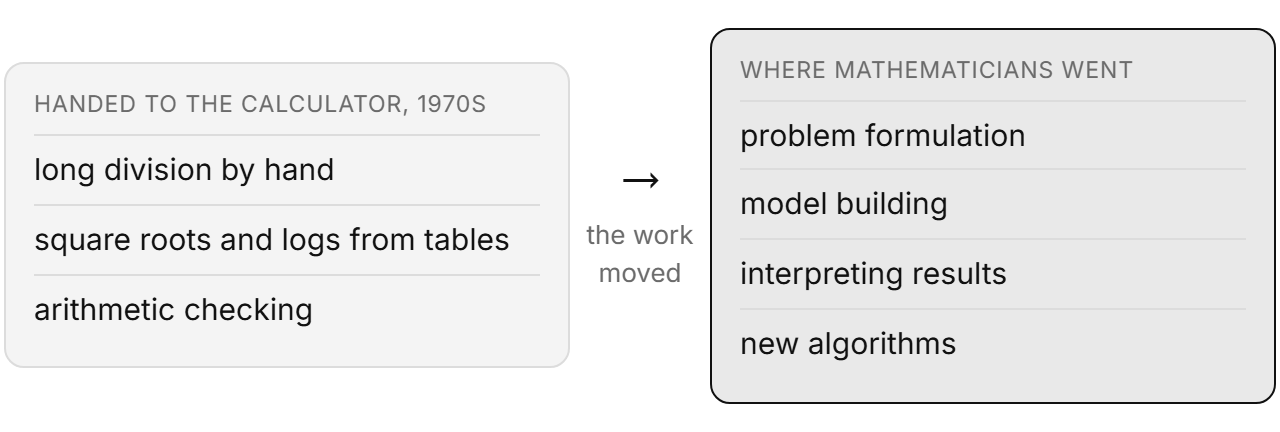
Despite initial resistance, calculators became indispensable tools, transitioning from a source of fear to a fundamental aid. Mathematicians, particularly those in applied fields, began to leverage calculators and later, more powerful computational tools, to tackle complex problems that were previously intractable. The profession did not disappear; rather, it evolved. Mathematicians shifted their focus from rote calculation to higher-level tasks such as problem formulation, model building, interpretation of results, and the development of new algorithms. The calculator, far from replacing them, augmented their capabilities, allowing them to explore more complex theoretical landscapes and solve real-world problems with greater efficiency. The "fear" eventually subsided as the benefits of augmentation became overwhelmingly clear and the profession adapted its practices and pedagogical approaches.
3. Engineers and the Rise of AI: Contemporary Anxieties
Today, AI, particularly with the advent of advanced machine learning and generative AI, is integrating into every facet of engineering, from automated design and predictive maintenance to complex simulations and intelligent control systems. This integration, however, is not without its challenges and anxieties among practicing engineers.
3.1. The Nature of AI Anxiety Among Engineers
Recent studies and industry reports highlight a growing sense of AI anxiety within the engineering profession, which goes beyond general automation anxiety:
- Fear of Job Displacement: This is a primary concern. Reports indicate that a significant percentage of engineering students (e.g., 69% of engineering students in a Deloitte 2025 study) believe their jobs are at risk due to AI. Practicing engineers worry about AI automating repetitive or even complex analytical tasks currently performed by humans (Al-Hammoud et al., 2025b).
- Deskilling and Erosion of Core Competencies: Similar to mathematicians' fears, engineers express concerns about AI systems performing tasks that traditionally required deep domain expertise, potentially leading to a devaluation of their "hard-won expertise" and a reliance on opaque AI outputs (Brückner, 2025). This raises questions about whether engineers might become mere "AI users" rather than skilled designers or analysts.
- Loss of Control and Trust Issues: AI's "black box" nature, where the decision-making process is not always transparent or interpretable, creates apprehension. Engineers, whose work often demands precision and accountability, worry about trusting AI in critical applications where errors could have severe consequences (Al-Hammoud et al., 2025b; Frontiers, 2025).
- Ethical Concerns: Issues like AI bias, data privacy, and the responsibility for AI-driven decisions contribute to anxiety. Engineers may fear being held accountable for AI system failures that are beyond their direct control or comprehension (Al-Hammoud et al., 2025b).
- Need for Continuous Reskilling and Adaptation Fatigue: The rapid pace of AI advancement necessitates constant learning and adaptation, leading to pressure and potential fatigue for engineers trying to keep pace with new tools and methodologies (Great Place to Work, 2025).
3.2. Parallels to the Calculator "Fear"
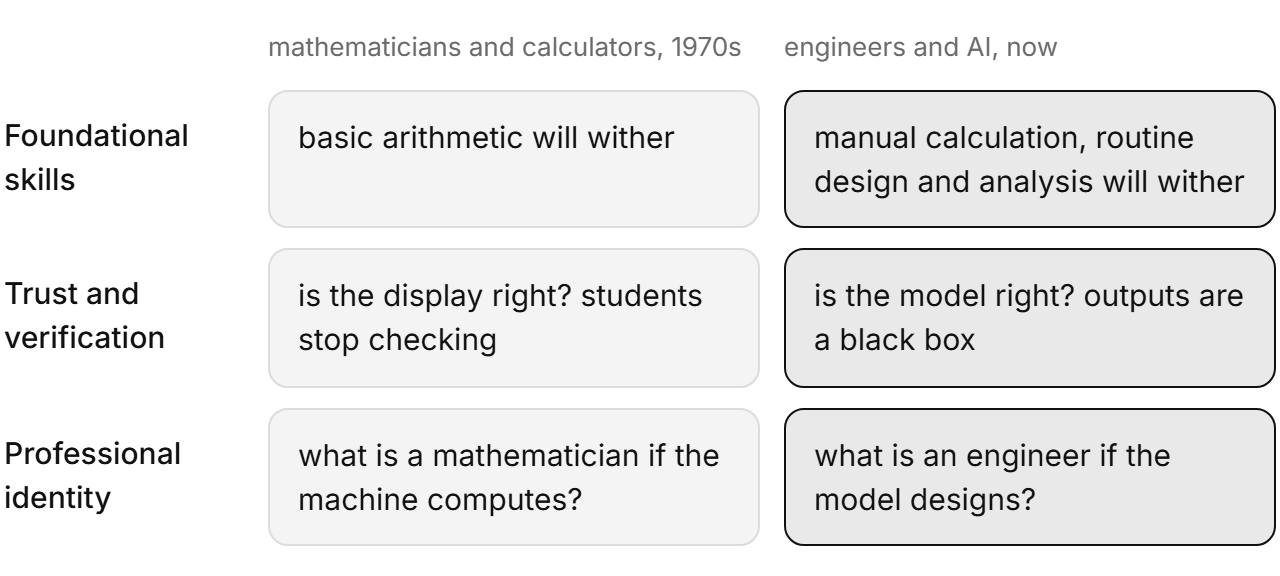
The anxieties observed among engineers regarding AI bear striking similarities to the historical apprehension surrounding calculators:
- Threat to Foundational Skills: Just as calculators were seen to threaten basic arithmetic, AI is perceived to threaten foundational engineering skills like manual calculation, basic design iterations, and routine data analysis.
- Trust and Verification: The initial distrust of calculator accuracy finds a parallel in the skepticism towards AI's reliability and the need for human oversight and validation of AI-generated results, especially in safety-critical applications.
- Professional Identity Crisis: Both technologies prompted a re-evaluation of what it means to be a "mathematician" or an "engineer." The shift from manual computation to conceptual understanding for mathematicians mirrors the current challenge for engineers to transition from purely technical execution to more strategic, ethical, and human-centric roles in collaboration with AI.
4. Filling the Research Gaps: A Proposed Framework
Despite the compelling analogy, significant research gaps exist that need to be addressed to fully understand and navigate the current period of technological transition for engineers.
4.1. Empirical Study on Practicing Engineers' Perceptions
Existing research often focuses on students or generalizes from broader automation anxiety. A critical gap is the lack of direct, in-depth empirical studies specifically investigating the nature, extent, and underlying reasons for "fear," "distrust," or "resistance" among practicing engineers across diverse disciplines (e.g., civil, mechanical, software, electrical) in real-world industrial settings. This would involve qualitative interviews to capture nuanced psychological impacts and large-scale surveys to quantify the prevalence of different fears, moving beyond general job market trends.
4.2. Deep Dive into Practicing Mathematicians' Historical Adaptation
While the educational impact of calculators is well-documented (Lee, 1998), there is a gap in a dedicated historical analysis of how practicing mathematicians (beyond educators) perceived and adapted to calculators. This research would explore:
- Were there debates within professional mathematical societies?
- How did core research methodologies and professional tasks shift?
- Was there a perceived threat to intellectual rigor or professional identity? This deeper historical context would provide richer comparative data for the AI-engineering analogy.
4.3. Comparative Analysis of "Fear" Mechanisms
A novel contribution would be a direct comparative analysis of the specific "fear" mechanisms (e.g., fear of deskilling, job displacement, loss of intellectual rigor, over-reliance, misleading outputs) between the historical case of calculators/mathematicians and the current case of AI/engineers. This would involve developing a framework to systematically map and compare these fears, their underlying causes, and their evolution across both historical and contemporary contexts.
4.4. Impact on Professional Identity and Expertise Redefinition
Beyond mere job displacement, research needs to explore how AI impacts the professional identity and perceived expertise of engineers. Do they feel their unique human skills are being devalued, or conversely, augmented and elevated by AI? This involves investigating how engineers envision their future roles in a human-AI collaborative environment, focusing on the human-centric skills that remain indispensable (e.g., creativity, critical thinking, ethical judgment, complex problem formulation).
4.5. Strategies for Mitigating Fear and Fostering Trust
Finally, there is a significant gap in empirically validated strategies specifically designed to mitigate the fear and distrust of AI among engineers, drawing lessons from how similar fears were addressed (or not) during historical technological shifts. This would include exploring the effectiveness of:
- Targeted AI Literacy Programs: Focusing on both technical understanding and the ethical implications.
- Human-AI Collaboration Frameworks: Designing AI tools as "co-pilots" that augment human capabilities rather than replace them, emphasizing explainable AI (XAI) and user control (Frontiers, 2025; Highways.Today, 2025).
- Transparent Communication: About AI's role and implications for job evolution within organizations (Great Place to Work, 2025).
- Policy and Ethical Guidelines: Developing clear guidelines for AI use in engineering to alleviate concerns about responsibility and bias.
5. Conclusion
The analogy between engineers fearing AI and mathematicians fearing calculators provides a powerful lens through which to understand and address the current technological anxieties. Just as calculators ultimately augmented mathematicians, AI has the potential to elevate the engineering profession by automating routine tasks and enabling the solution of previously intractable problems.
However, recognizing and actively addressing the legitimate fears of engineers (concerning job security, deskilling, professional identity, and trust in autonomous systems) is paramount. By filling the identified research gaps through rigorous empirical studies and comparative historical analysis, the engineering community can move from apprehension to proactive adaptation. The goal should not be to resist AI, but to strategically integrate it as a collaborative tool, fostering "human-AI superagency" (McKinsey & Company, 2025) where human ingenuity is amplified, leading to unprecedented innovation and a redefined, yet robust, future for engineering.
References
- Al-Hammoud, M. A., et al. (2025). Engineering Students' Perceptions of AI and Educational Innovations in the Academic Setting. ResearchGate (Preprint/Working Paper).
- Al-Hammoud, S., et al. (2025). Ethics of Artificial Intelligence and Robotics in the Architecture, Engineering, and Construction Industry. arXiv (Preprint).
- Brückner, M. (2025, May). AI: The Calculator Wars Revisited. Micro Musings for thought leaders.
- Deloitte. (2025). Campus Workforce Trends: Placement Cycle 2025. (As cited in Times of India, 2025, July 7).
- Frontiers. (2025, January 6). Human-AI collaboration is not very collaborative yet: a taxonomy of interaction patterns in AI-assisted decision making from a systematic review.
- Great Place to Work. (2025, May 15). Workplace Anxiety in 2025: Navigating Mental Health Amid AI and Economic Uncertainty.
- Highways.Today. (2025, June 18). Human + AI to Reimagine R&D with Smarter, Collaborative Machine Learning.
- Lee, H. L. (1998). Impacts of Using Calculators in Learning Mathematics. Proceedings of the 3rd Asian Technology Conference in Mathematics (ATCM'98).
- Marín-Marín, J. M., et al. (2025). Transformations in academic work and faculty perceptions of artificial intelligence in higher education. Frontiers in Education.
- McKinsey & Company. (2025, January 28). Superagency in the workplace: Empowering people to unlock AI's full potential.
- ResearchGate. (2025, March 15). AI Anxiety: A Comprehensive Analysis of Psychological Factors and Interventions.
- ResearchGate. (2025, April 9). Mitigating the effect of AI anxiety on employees' creativity: a social cognitive perspective.
- Taylor & Francis Online. (2024). Moving beyond conventional resistance and resistors: an integrative review of employee resistance to digital transformation.
- UNCTAD. (2025, April 7). Technology and Innovation Report 2025: Inclusive Artificial Intelligence for Development.